The Architecture Orphaning Problem with AI Agents

Spec-Driven Development (SDD) has become the new cool thing to try in AI-assisted software development. It has drawn apologists, critics, and apologist-turned-critics. And somehow, they all have a point. But how? The Suggestible Actor model and its guardrail erosion corollary explain those objections — and provide a mechanism to address them.
Spec-Driven Development: why is it useful, when others failed?
SDD (Böckeler 2025, Bouchard 2026) iterates between structured specifications and human review gates until the spec is unambiguous enough to generate code. It correctly shifts the developer’s job from “write code” to “define what correct means.” SDD is arguably the first directionally right attempt at an AI-native development pattern.
Every prior spec-first methodology (Waterfall, design-by-contract, CASE tools) failed because specification was additional to implementation. You spent effort on the spec, then more on the implementation. The latter is necessary and expensive, and so people often forgo the former.
Generative AI changed that cost calculus. Implementation is cheaper, but it erodes guardrails systematically. Specifications appear to be the antidote: the surplus human attention goes to spec development as a foil against erosion. Hence SDD.
But how does SDD resist guardrail erosion? The Suggestible Actor model and its guardrail erosion corollary reveal that there is always a directive gap between what you specified and what you meant. The iterative process of testing a specification against the produced code and refining the specification in response narrows this directive gap to the point of functional correctness.
However, there is a layer in software design that iteration cannot reach: architectural constraints.
Architecture orphaning
While a spec describes WHAT the system should do, it does not describe HOW it should do it. Questions such as “which library to use” and “which boundaries to respect” are outside the spec. A spec can state architectural constraints, but behavioral tests derived from that spec cannot enforce them. A test that verifies correct output passes whether the code calls a shared service or reimplements the logic inline. Stating the constraint is easy; detecting violations through the spec-to-test pipeline is the gap.
The WHAT and the HOW are two distinct layers in software design. In traditional development, one human holds both layers in the same head. With LLMs, the layers separate, and architectural decisions fall between:
- The spec’s test pipeline cannot enforce it (behavioral tests don’t verify architectural choices)
- The LLMs cannot infer it (architecture is system-level, non-local; the suggestible actor reasons locally)
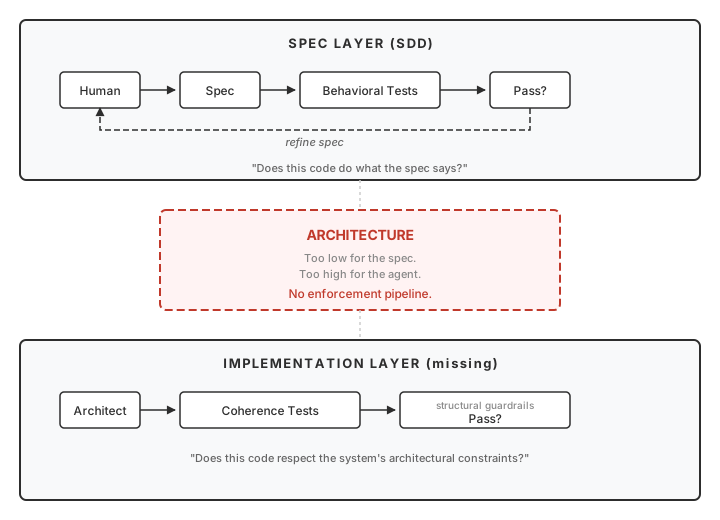
Architecture becomes an orphaned layer: too low for the spec, too high for the locally reasoning agent. Sure, SDD lists architecture as a design phase; but listing is not the same thing as governing. Architectural decisions remain invisible to the behavioral test.
SDD critics are really talking about architecture orphaning
Critics come from different directions, but look closer: they are observing symptoms of architecture orphaning without diagnosing it.
Canciani (“Code over Specs,” May 2026) proposes “fitness functions” — architectural tests that enforce structural boundaries: “You aren’t writing a spec; you are setting a hard boundary.” He also advocates Architectural Design Records (ADRs) as “case law” that stops AI from re-litigating settled architectural decisions. Canciani is arguing for structural guardrails without the theoretical grounding for why specs can’t do this work.
Dev.to/REAP (“Why SDD Fails,” May 2026) states it directly: “The same specification produces different implementations across different runs — varying architectural choices, data structures, and error handling.” That sentence is architecture orphaning as empirical observation. Their fix is evolving “Genomes” of principles and conventions: richer context for the agent, but still a social guardrail (one of the least robust guardrails). The agent can violate it when the local context moves past these conventions.
Konrad et al. (“Architecture Without Architects,” Apr 2026) arrive at the phenomenon empirically. AI coding agents select frameworks, scaffold infrastructure, and wire integrations in seconds: “These are architectural decisions, yet almost no one reviews them as such.” They coin the term “vibe architecting” — architecture shaped by prompts rather than deliberate design — and confirm that prompt wording alone produces structurally different systems for the same task. This is architecture orphaning observed in the wild, with independent terminology.
The consequences are already measurable. Huang et al. (2026) find that LLM agents disregard code reuse opportunities, and that reviewers express more positive emotions toward AI-generated code than human code: surface plausibility masks structural damage. GitClear’s analysis of 153 million lines tells the same story: less refactoring, more copy-paste, code that “resembles an itinerant contributor.”
A separate layer for architectural governance
For AI-assisted software development, we need two distinct layers of governance: (1) iterative spec convergence, which is what SDD provides, and (2) architectural coherence, which structural guardrails provide.
Iterative specification convergence (spec layer) handles functional correctness. The human iterates on the spec; the LLM regenerates; verification narrows the directive gap. It happens for each feature and frequently. This is what SDD does at its best.
Architectural coherence (implementation layer) handles architectural drift and ensures drift is deliberate. Enforcement is expressed per-system, requires high investment (human effort), and changes slowly. This is what SDD lacks and cannot provide, because SDD operates entirely at the spec layer.
Neither substitutes for the other; they complement each other. Convergence verifies “does this code do what the spec says?” Structural guardrails verify “does this code respect the system’s architectural constraints?” The spec cannot enforce architecture through its test pipeline without collapsing the abstraction, and structural guardrails cannot close the directive gap.
Both layers produce tests, but these two types of tests are distinct. SDD produces behavioral tests (e.g., “given valid credentials, return 200”) that pass regardless of how the behavior is satisfied. Architectural coherence tests verify structure: they are derived from the architecture document, not the spec, and encode structural decisions as test constraints.
What does architectural coherence look like?
Your architecture says all authentication goes through the auth service. The SDD behavioral test (“given valid credentials, return 200”) passes whether the code calls the auth service or reimplements auth inline. The architectural coherence test: a build-system visibility rule that prevents the user-facing service from importing auth implementation libraries directly. It can only depend on the auth service client. That rule lives in CI configuration the agent cannot modify. Violation is a build failure, not a review comment.
With such tests in place, the architect’s job shifts from drawing boxes and arrows to designing types, build rules, and capability boundaries. The tooling for this is nascent: today, building architectural coherence tests is a manual investment per system. That investment is the cost of the two-layer governance model, and it is a tooling gap the ecosystem has not yet closed.
SDD promised to harness the power of AI coding agents without the quagmire of multi-generational vibe coding. But that promise comes with a near-fatal loss of architectural coherence. This is a genuine trade-off that you cannot reclaim without paying with the scarcest resource: human attention that builds and maintains your structural guardrails.
Linked in this post

The Guardrail Erosion Problem with AI Agents

The Suggestible Actor: A New Model for AI-Assisted Software Development
Architecture Orphaning
Architecture orphaning is the phenomenon where architectural decisions fall between layers that neither specs nor AI agents can govern.
Behavioral Tests vs. Architectural Coherence Tests
Behavioral tests and architectural coherence tests serve different governance layers and should not be conflated.
Convert Ambient Knowledge into Local Context
The core design principle for the suggestible actor: convert ambient knowledge into local context.
Social Guardrails
Social guardrails are conventions and patterns, documented or not, that form the social contract around which humans write software.
Structural Guardrails
Structural guardrails are guardrails woven into the structure of software development that cannot be modified in situ.
The Directive Gap
The directive gap is the distance between the human's goal (with all their ambient knowledge) and the context actually available to the agent during execution.
Two-Layer Governance Model
AI-assisted software development requires two distinct, complementary layers of governance: iterative spec convergence and architectural coherence.